
Impurity Standards and Advanced Impurity Profiling Using High-Field In-House NMR at Pharmaffiliates
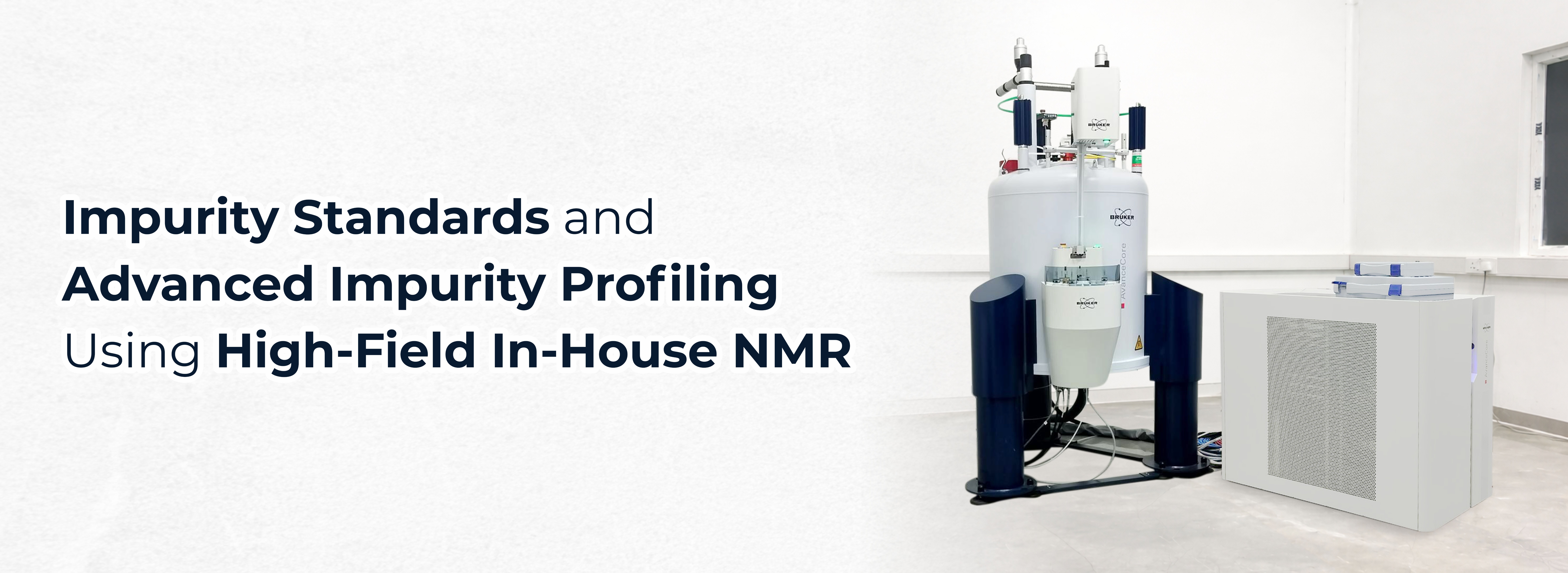
Impurity characterization is a critical scientific and regulatory requirement across pharmaceutical development, directly impacting product quality, patient safety, and regulatory acceptance. As synthetic routes become more complex and regulatory thresholds increasingly stringent, the need for unambiguous structural identification and accurate purity assignment of impurities has intensified. Conventional chromatographic and mass spectrometric techniques, while indispensable for detection and quantification, often lack the structural resolution required for definitive impurity identification. In this context, high-field Nuclear Magnetic Resonance (NMR) spectroscopy represents the most authoritative tool for impurity characterization.
At Pharmaffiliates, impurity profiling and impurity standard development are supported by latest-generation, high-field in-house NMR instrumentation, enabling rapid, precise, and regulator-ready impurity characterization without reliance on external laboratories.
Regulatory Context and Scientific Expectations
Global regulatory frameworks, including ICH Q3A, Q3B, Q6A, and ICH M7, mandate that impurities above identification and qualification thresholds be structurally characterized and scientifically justified. Regulators increasingly expect clear structural evidence, traceable purity assignment, and lifecycle impurity control strategies. Inadequate impurity characterization remains a common cause of regulatory queries, particularly for unknown, process-related, and degradation impurities.
NMR-based structural elucidation plays a central role in meeting these expectations, especially when impurities are closely related to the parent API or present as positional isomers, stereoisomers, or low-level degradation products.
Impurity Standards: Structural and Metrological Considerations
Impurity standards must meet stringent scientific criteria, including confirmed molecular structure, well-defined stereochemistry where applicable, and accurately assigned purity. At Pharmaffiliates, impurity standards are either custom synthesized through targeted chemical routes or isolated from stressed or process streams, followed by rigorous structural confirmation using orthogonal techniques. Quantitative NMR (qNMR) is applied as a primary metrological method for purity assignment, providing SI-traceable, absolute purity values without dependence on secondary reference materials. This approach ensures high confidence in impurity standard calibration, particularly for novel or non-commercially available impurities.
Advanced Role of High-Field NMR in Impurity Profiling
NMR spectroscopy uniquely enables direct observation of atomic connectivity and molecular architecture. Unlike MS-based approaches, NMR does not rely on fragmentation patterns but instead provides definitive structural proof through chemical shift analysis, scalar coupling, and through-bond and through-space correlations. Pharmaffiliates’ latest-model high-field NMR systems offer enhanced sensitivity, resolution, and spectral clarity, allowing reliable characterization of impurities at low mass and concentration levels. Advanced digital RF control, automated shimming, and temperature-stabilized acquisition ensure reproducibility and data integrity, which are critical for regulatory documentation.
Multidimensional NMR for Definitive Structural Elucidation
Comprehensive impurity characterization routinely involves a combination of ¹H and ¹³C NMR supported by multidimensional experiments such as COSY, HSQC, and HMBC. These experiments enable precise assignment of proton–proton and proton–carbon connectivities, allowing confident differentiation between Regio isomeric and stereochemical variants. Where required, NOESY or ROESY experiments are employed to establish spatial relationships and stereochemical orientation.
This integrated NMR strategy is particularly valuable for genotoxic impurities, nitrosamine-related species, chiral impurities, and late-stage degradation products, where structural ambiguity can have significant regulatory consequences.
Integrated Impurity Profiling Workflow
At Pharmaffiliates, impurity profiling is approached as a scientifically integrated process rather than a standalone analytical exercise. Impurities are generated through controlled process simulations or forced degradation studies, followed by isolation or targeted synthesis. Structural elucidation using high-field NMR is complemented by LC–MS and chromatographic purity assessment, culminating in impurity standard qualification supported by qNMR. This end-to-end approach ensures consistency between impurity origin, structure, and analytical control strategy, aligning impurity data across development, validation, and regulatory submission stages.
Regulatory and Developmental Advantages of In-House NMR
The availability of advanced in-house NMR infrastructure significantly reduces project timelines and enhances data confidentiality while enabling real-time scientific decision-making. From a regulatory standpoint, NMR-backed impurity characterization strengthens submissions by providing unequivocal structural justification, reducing the risk of deficiency letters and follow-up queries.
Conclusion
As pharmaceutical impurity profiles grow increasingly complex, high-field NMR has become indispensable for definitive impurity characterization and standard qualification. By combining latest-generation in-house NMR technology with deep expertise in synthetic and analytical chemistry, Pharmaffiliates delivers impurity profiling solutions that are scientifically rigorous, regulator-aligned, and development-focused.
For advanced impurity standards and NMR-driven impurity profiling , partner with Pharmaffiliates for precision, confidence, and regulatory readiness.


Leave a Reply