

Analytical R&D in Pharma: Ensuring Compliance and Speed in Drug Development
Analytical research and development plays a defining role in modern pharmaceutical science. As drug molecules become more complex and regulatory expectations continue to rise, organizations increasingly depend on analytical data to guide formulation decisions, validate manufacturing processes, assess impurities, and support global submissions. Analytical R&D is therefore not only a technical discipline but also a strategic function that shapes the quality, safety, and lifecycle success of every drug product.
Today’s pharmaceutical environment demands two core outcomes from analytical operations: regulatory compliance and timely execution. Companies must meet stringent international guidelines such as ICH, GLP, GMP, while ensuring that analytical evaluations keep pace with accelerated development timelines. This balance of accuracy, reliability, and speed is essential for efficient drug development, and organizations often turn to specialized analytical CROs to meet these expectations.
The Central Role of Analytical R&D Throughout the Drug Development Process
Analytical R&D supports every stage of development, from early molecule characterization to commercial validation. Its contributions ensure that decisions are backed by robust data and that each regulatory milestone is achieved without delay.
1. Method Development and Validation
Developing a selective, precise, and reproducible analytical method is foundational to characterizing APIs, excipients, impurities, and degradation products. Modern method development follows risk-based and QbD-driven approaches, allowing scientists to understand critical method parameters and build methods capable of long-term reliability. Validation under ICH Q2(R2) guidelines ensures that methods meet global expectations for specificity, linearity, accuracy, precision, range, detection limits, and robustness.
2. Impurity Profiling and Structural Elucidation
Impurity evaluation remains a priority for regulators because unidentified or uncontrolled impurities can compromise drug safety. Analytical R&D uses LC-MS/MS, GC-MS, NMR, and high-resolution mass spectrometry to identify, quantify, and characterize impurities. Detailed impurity profiling supports compliance with ICH Q3A/Q3B, helps define impurity limits, and strengthens regulatory filings. Structural elucidation also supports synthetic optimization by defining impurity origins and formation pathways.
3. Stability-Indicating Method Development
Stability-indicating methods (SIMs) provide a clear understanding of degradation patterns under normal and stressed conditions. These methods must separate the active ingredient from all degradation products and impurities. SIMs built according to ICH Q1A-Q1F requirements are essential for long-term stability studies, accelerated studies, and shelf-life assignment.
4. Forced Degradation Studies
Forced degradation is a scientific exercise that helps predict how a drug behaves under stress. Exposure to thermal, photolytic, oxidative, and hydrolytic conditions reveals critical degradation pathways. Forced degradation insights accelerate SIM development, support pharmacopoeial compliance, and strengthen regulatory risk assessments. As expectations increase around structural elucidation and impurity qualification, forced degradation has become a core analytical responsibility.
Through these interconnected activities, analytical R&D ensures that pharmaceutical products meet quality expectations at every stage, from early research through commercialization.
Why Compliance Is Non-Negotiable: Meeting ICH, GLP, and GMP Standards
Regulators worldwide place significant emphasis on the integrity and reliability of analytical data. Non-compliance in method validation, documentation, data integrity, or laboratory practices can delay product approvals, trigger audit findings, or jeopardize entire development programs.
ICH-Aligned Method Validation
ICH Q2(R2) provides a harmonized framework for method validation, ensuring methods are thoroughly characterized. Updated guidelines emphasize enhanced analytical understanding, improved documentation, and lifecycle-based method management. Robust ICH-compliant validation ensures global regulatory acceptance.
GLP and GMP Execution
Analytical operations performed in certified GLP/GMP laboratories ensure:
- Qualified instruments and calibrated systems
- Controlled laboratory environments
- Standardized SOP-driven processes
- Trained scientific personnel
- Data integrity practices aligned with ALCOA+ principles
- Traceable, audit-ready documentation
These practices protect data credibility and enhance regulatory confidence.
Audit-Ready Documentation
Regulators expect transparent, complete, and traceable documentation. Clear reporting, structured data files, validated templates, and unified documentation systems ensure that analytical reports withstand regulatory scrutiny.
Meeting these compliance requirements demands expertise, disciplined execution, and well-established quality systems, factors that drive many pharmaceutical organizations to collaborate with specialized CROs.
The Importance of Speed: Accelerating Analytical Deliverables Without Compromising Quality
While compliance establishes trust, speed drives development efficiency. Delays in analytical execution can slow down formulation optimization, manufacturing decisions, and regulatory filings. Organizations therefore prioritize analytical partners who combine scientific depth with operational agility.
Rapid Method Development and Optimization
Efficient workflows, domain expertise, and structured experimental designs shorten development time. QbD-based strategies minimize iterations by building scientific understanding early in the process.
Parallel Execution of Analytical Activities
Modern analytical CROs run multiple activities simultaneously, method validation, forced degradation, impurity profiling, and stress studies, reducing overall timelines.
Immediate Access to Reference Standards and Impurities
Having certified reference standards, custom impurities, and isotope-labeled compounds readily available accelerates method qualification and impurity studies. When these materials are supplied by the same CRO performing the analysis, timelines improve significantly.
Efficient Data Management and Reporting
Validated software systems, digitized workflows, and structured reporting accelerate document preparation and reduce the time from testing to submission-ready data.
These efficiencies ensure project milestones are met without compromising scientific rigor.
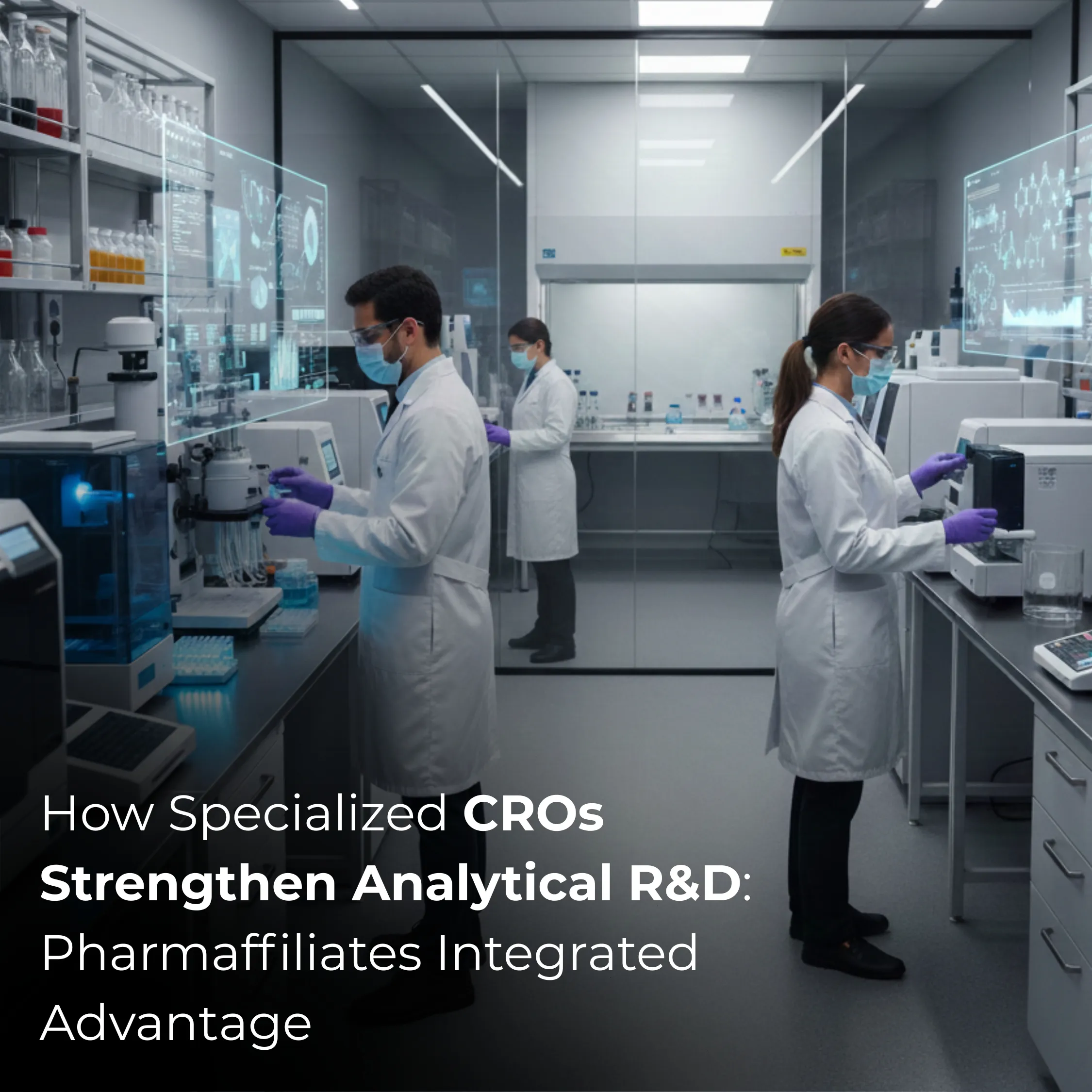
How Specialized CROs Strengthen Analytical R&D: Pharmaffiliates Integrated Advantage
The complexity of today’s analytical requirements has increased demand for CROs with integrated capabilities. Scientific, regulatory, and operational. Pharmaffiliates supports global pharmaceutical clients with a comprehensive analytical platform designed to meet evolving industry needs.
Advanced Instrumentation and Skilled Expertise
With LC-MS/MS, GC-MS, NMR, HPLC, UHPLC, FT-IR, UV-Vis, and other analytical technologies, Pharmaffiliates performs in-depth characterization, impurity profiling, degradation studies, and structural elucidation with scientific precision.
Strength in Impurity Profiling
Analytical chemists and structural experts provide detailed impurity profiling aligned with global guidelines, helping clients understand impurity origins, classify degradation products, and strengthen impurity control strategies.
Stability-Indicating Method Development and Validation
Dedicated stability and validation teams develop and validate SIMs that remain robust throughout the product lifecycle. Forced degradation studies are executed with precision to ensure clear understanding of degradation pathways.
GLP/GMP-Aligned Analytical Services
Pharmaffiliates operates through well-defined quality systems, validated instrument controls, trained personnel, and strict adherence to GLP/GMP requirements to ensure all analytical outputs meet global regulatory expectations.
Fast Turnaround Through Integrated Capabilities
In-house availability of impurities and reference standards significantly reduces sourcing delays. Combined with parallel workflows and efficient documentation practices, Pharmaffiliates ensures timely delivery of analytical reports.
Regulatory Documentation Support
Pharmaffiliates prepares complete, audit-ready documentation including method validation reports, impurity summaries, forced degradation assessments, and CTD-compatible modules.
Partner with Pharmaffiliates for Reliable, Regulatory-Ready Analytical Support
In an environment defined by rising regulatory expectations and compressed development timelines, pharmaceutical organizations require analytical partners who deliver scientific precision with operational efficiency. Pharmaffiliates offers a comprehensive platform for ICH-compliant analytical validation, impurity profiling, stability-indicating method development, and GLP/GMP-aligned analytical services, supported by advanced instrumentation and a skilled scientific workforce. With integrated access to high-quality reference standards and impurities, Pharmaffiliates ensures faster turnaround and consistent data integrity across projects.
If you are seeking a trusted analytical CRO to strengthen compliance, accelerate development, and support global submissions, connect with Pharmaffiliates to discuss your analytical needs and explore tailored solutions for your upcoming programs.


