

Green Chemistry and Analytical Process Understanding in Pharmaceutical R&D: Advancing Sustainable and Data-Driven Development
Pharmaceutical R&D has entered a new phase where innovation, sustainability, and scientific precision must progress together. As global expectations shift toward cleaner and more efficient development practices, the principles of green chemistry and analytical process understanding have become essential. These approaches help organizations design safer workflows, minimize waste, and generate more meaningful data for decision-making.
For modern drug development teams, sustainability is not limited to large-scale manufacturing. It begins at the earliest stages of R&D. Cleaner reactions, reduced solvent use, controlled impurities, and scientifically optimized analytical methods support both environmental goals and regulatory expectations. In this evolving landscape, analytical partners with strong characterization capabilities and a disciplined scientific framework play a critical role.
Pharmaffiliates supports this shift by integrating green-chemistry-aligned analytical strategies, impurity profiling, reference standard support, and robust analytical method development to help teams understand reactions more deeply and make informed process decisions.
Why Green Chemistry Matters in Early Pharmaceutical Research
Green chemistry is a scientific philosophy that focuses on designing inherently safer, cleaner, and more resource-efficient chemical workflows. While often associated with large-scale production, its foundations are particularly relevant to early development, where reaction pathways, impurity formation, and solvent choices first take shape.
Key Drivers for Green Chemistry Integration in R&D
- Cleaner scientific workflows Reduced hazardous reagents and thoughtful solvent selection strengthen safety and limit environmental burden.
- Better control over impurities from the early stages Understanding how reaction conditions influence impurity formation allows refinements before scale-up.
- Regulatory encouragement toward sustainable development Agencies increasingly emphasize environmental responsibility, including the use of greener solvents and safer practices.
- Operational efficiency in downstream steps Cleaner reactions often mean simpler purification and fewer analytical challenges.
Competitor CROs frequently highlight green chemistry at the manufacturing scale, but Pharmaffiliates’ strength lies in applying these concepts at the analytical and impurity-characterization level, where early insights significantly influence overall sustainability.
Analytical Process Understanding: A Scientific Foundation for Cleaner Development
While green chemistry guides scientific intent, analytical data provides the clarity needed to make informed decisions. Analytical process understanding examines how reaction conditions, solvents, reagents, and environmental factors influence the quality and purity of intermediates and APIs.
Pharmaffiliates supports this through:
- Impurity profiling (LC-MS/MS, GC-MS, NMR)
- Structural elucidation
- Degradation pathway evaluation
- Stability-related analytical insights
- Availability of impurity reference standards
These capabilities help R&D teams understand and refine processes with scientifically supported data, without implying manufacturing, engineering, or scale-up work.
Understanding Process Behaviour Through Analytical Insights
1. Impurity Profiling to Support Cleaner Chemistry
Impurities help reveal how a process behaves. Even early reactions produce by-products, intermediates, or degradation species that require detailed evaluation.
Pharmaffiliates performs:
- Advanced LC-MS/MS profiling
- Structural elucidation through NMR and HRMS
- Pathway-based impurity interpretation
- Custom impurity synthesis for method development
These insights help researchers refine reagent choice, solvent compatibility, and reaction conditions in a way that supports both quality and sustainability.
2. Forced Degradation to Understand Stability and Reaction Pathways
Forced degradation is a controlled scientific exercise, not manufacturing stress testing. It clarifies how an active ingredient responds to environmental factors.
Pharmaffiliates conducts:
- Thermal degradation studies
- Oxidative and hydrolytic stress
- Photolytic stress assessments
- Pathway-level degradation interpretation
Understanding degradation pathways allows teams to design cleaner, more stable processes during early research.
3. Analytical Method Development for Greener and More Efficient Studies
Even analytical workflows can embrace sustainability. Well-designed methods help reduce solvent use, shorten run times, and improve efficiency.
Pharmaffiliates develops:
- Stability-indicating methods
- Impurity-specific assays
- Chromatographic methods using greener solvent systems where feasible
- ICH-aligned validation (Q2 R2)
Cleaner analytical methods support cleaner development not by manufacturing processes, but through smarter, more efficient scientific practices.

Sustainability Through Smart Analytical Planning
Sustainability in pharmaceutical R&D does not depend solely on how a process is scaled. Early decisions, supported by analytical clarity, have the most lasting impact.
Pharmaffiliates contributes to sustainability through:
- Reduced reliance on hazardous solvents in analytical methods
- Precise impurity qualification using certified standards
- Data-driven understanding of reaction behaviour
- Minimized re-experimentation through robust method development
- Integration of green-chemistry considerations into impurity and degradation studies
This approach promotes sustainability without implying industrial manufacturing involvement.
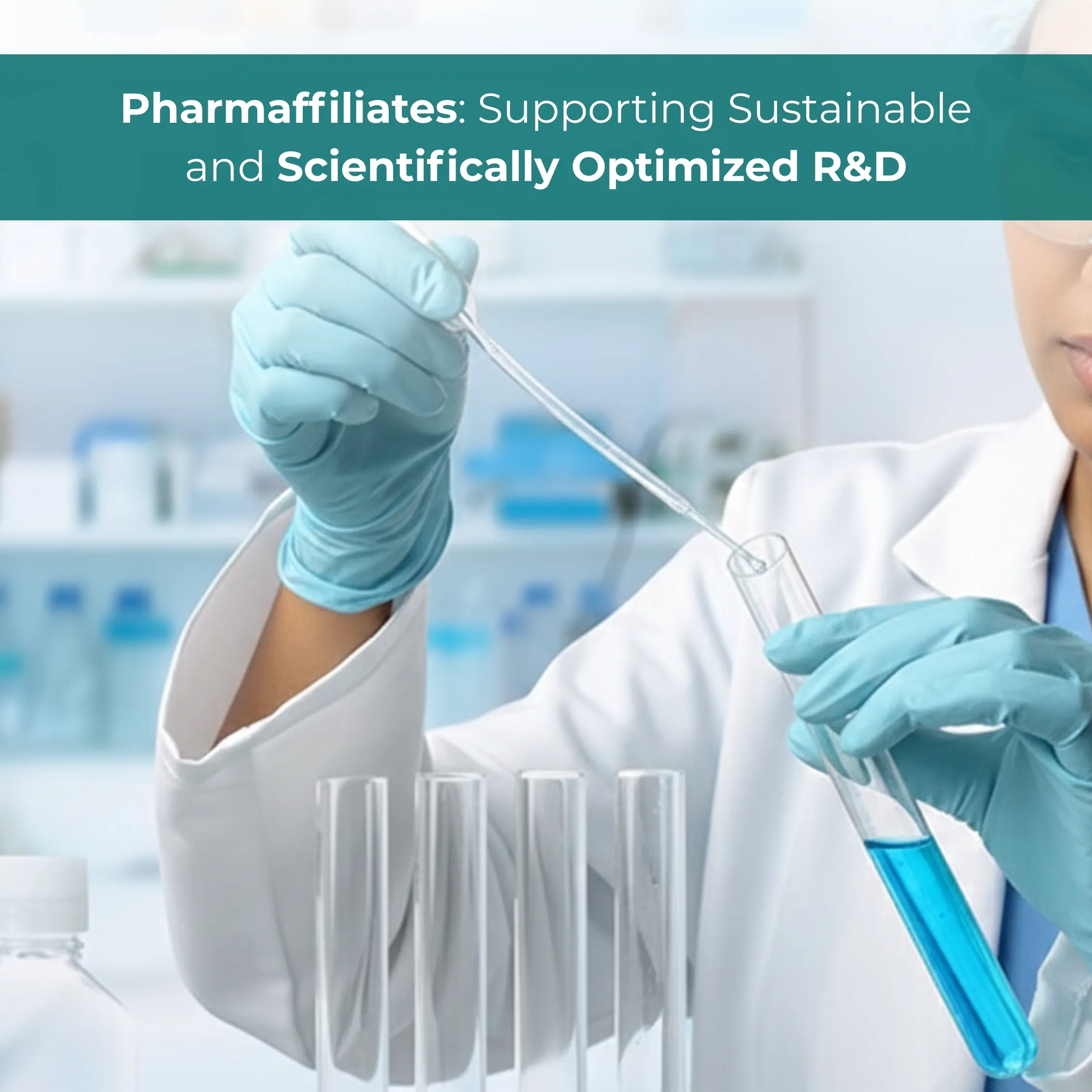
Pharmaffiliates: Supporting Sustainable and Scientifically Optimized R&D
Pharmaffiliates’ strengths lie in analytical science, impurity chemistry, and reference standard development, which directly support cleaner and more informed pharmaceutical development decisions.
1. Analytical Integration Aligned with Green Chemistry Principles
Pharmaffiliates ensures analytical studies consider:
- Safer solvent systems
- Reduced reagent loads
- Cleaner workflows for impurity assessment
- Environmentally conscious analytical strategies
This aligns with green chemistry thinking while remaining within the scope of analytical services.
2. Impurity Profiling and Structural Elucidation for Process Clarity
Understanding why impurities form is central to making any process cleaner. Pharmaffiliates’ teams deliver:
- Impurity origins
- Predictive formation pathways
- Synthetic support for impurity standards
- LC-MS and NMR-based structural confirmation
These outputs guide scientists in refining their chemistry responsibly.
3. Availability of High-Quality Standards for Cleaner Analytical Studies
Ready access to impurity standards, metabolites, and stable isotope-labelled compounds reduces development delays and supports reliable analytical evaluation.
Pharmaffiliates catalogue and custom synthesis capabilities ensure:
- Faster qualification of impurities
- Reproducible method development
- Clarity in degradation and stability assessments
4. Regulatory-Ready Analytical Outputs
Pharmaffiliates provides documentation suitable for regulatory submissions, including:
- Method validation reports
- Impurity summaries
- Forced degradation reports
- Characterization data packages
These deliverables support compliance without implying manufacturing services.
Conclusion:
Green chemistry and process understanding form the foundation of modern pharmaceutical innovation. While large-scale sustainability is important, meaningful progress begins with the analytical clarity and impurity insights generated during early research.
Pharmaffiliates supports this transition by delivering:
- Green-aligned analytical strategies
- Deep impurity understanding
- Certified reference standards
- ICH-compliant analytical methods
- Precise structural elucidation
All of which help teams design cleaner, safer, and more informed development pathways.


